Emotional Anesthesia: When Nothing Hurts Because Nothing Reaches You
The mind sometimes lowers the volume on pain to survive. The tragedy begins when joy, love, and connection become quiet too.

There is a kind of pain that cries. And then there is another kind, the one that becomes so tired it forgets how.
There are mornings when you wake up and do everything expected of you.
You answer messages. You attend meetings. You laugh when everyone else laughs. You complete your work, ask people how they are doing, and say, “I’m fine,” when they return the question.
From the outside, nothing appears broken.
Inside, however, nothing seems to arrive.
Bad news does not destroy you. Good news does not excite you. The song that once understood your soul becomes background noise. Someone tells you they love you, and although you understand the words, you cannot find the feeling that is supposed to answer them.
You are not exactly sad.
You are not exactly peaceful either.
You are simply absent from your own emotional life.
This strange silence is sometimes called emotional anesthesia.

The Silence After Too Much Noise
We usually imagine emotional suffering as something visible.
Tears. Anger. Panic. Sleepless nights. Shaking hands. A voice collapsing in the middle of a sentence.
But not every overwhelmed person looks overwhelmed.
Some people become quieter.
Some become extremely productive.
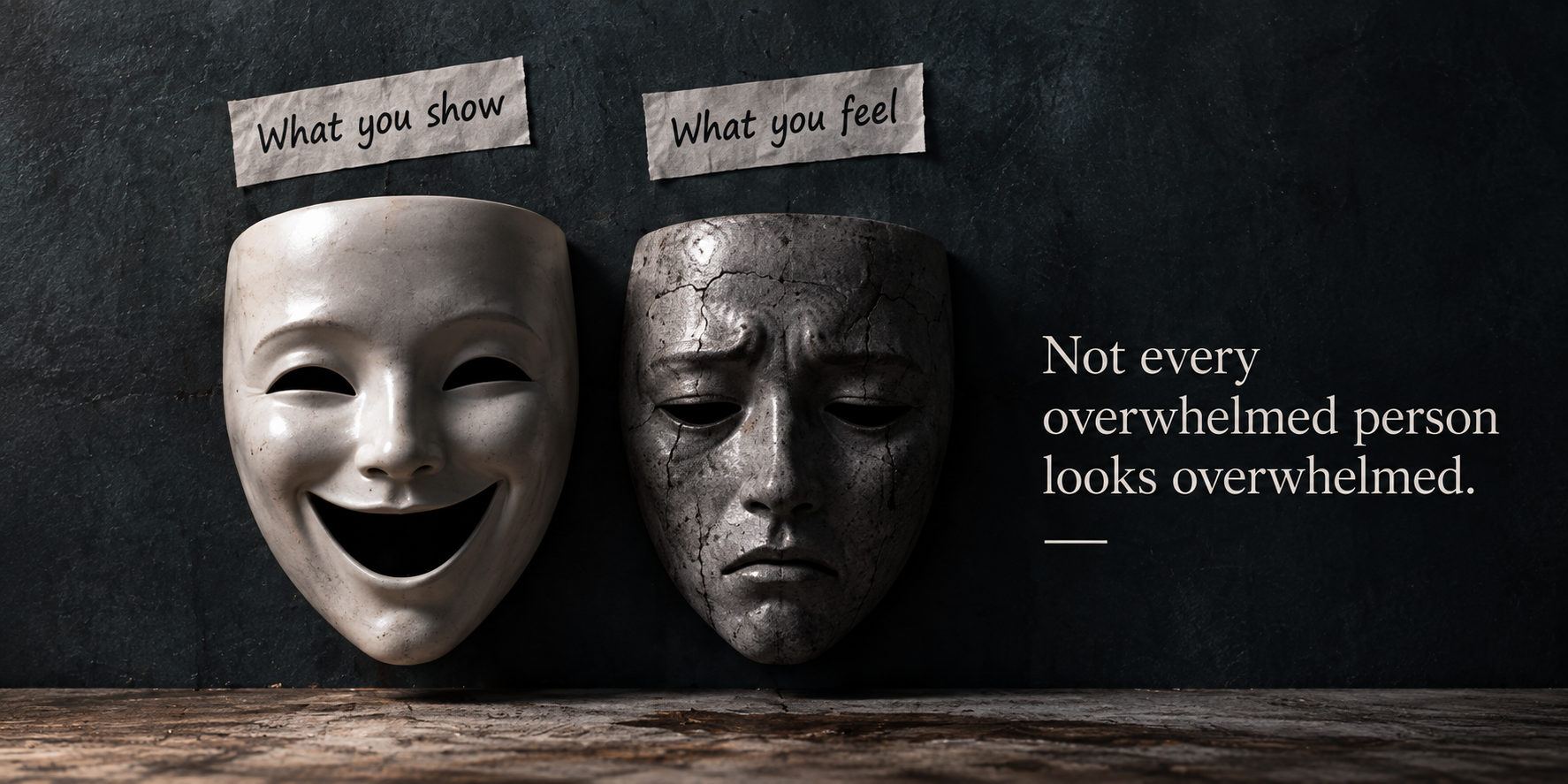
Some learn to discuss their pain as if they were presenting a report about someone else’s life. They can explain exactly what happened, why it hurt, and what it changed,but their voice carries no emotional weight.
That absence is often mistaken for strength.
“You handled it so well.”
“You’ve become so mature.”
“You’re finally over it.”
Perhaps.
But sometimes what looks like recovery is actually disconnection.
Healing allows us to remember pain without being controlled by it. Emotional anesthesia makes the pain feel unreachable, not necessarily resolved.
There is a difference.
What Emotional Anesthesia Really Means
Emotional anesthesia describes a state in which emotions feel muted, distant, flattened, or inaccessible. A person may struggle to feel sadness, happiness, affection, excitement, grief, anger, or emotional connection with the intensity they once did.
In mainstream clinical sources, this experience is more commonly discussed as emotional numbing, emotional blunting, difficulty experiencing positive emotions, or detachment. It can appear as part of post-traumatic stress, depression, dissociation, grief, and other psychological experiences. (National Institute of Mental Health)
That distinction matters.
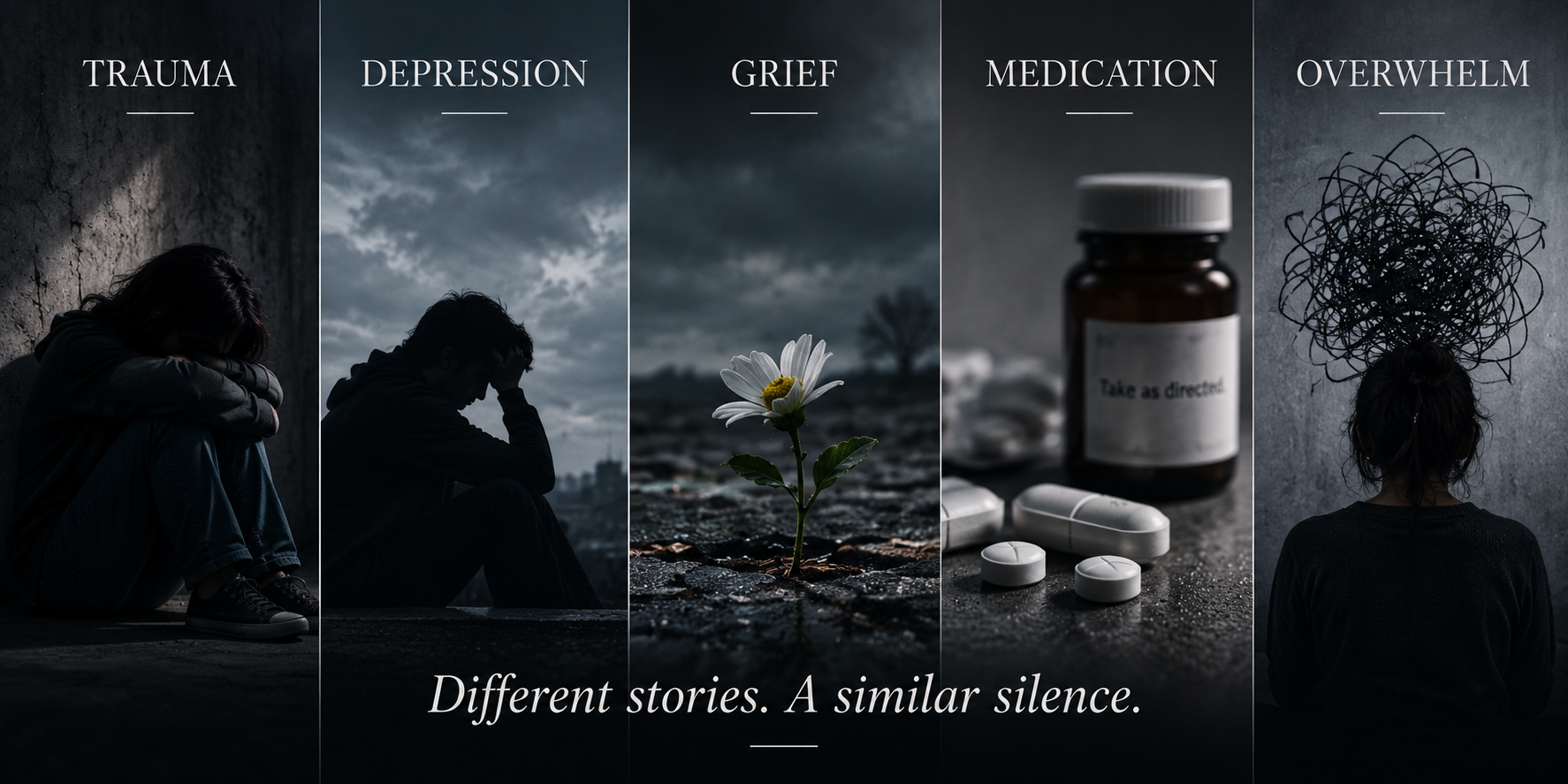
Giving an experience a name can make us feel understood. But a poetic name cannot tell us what caused it.
Calling everything “emotional anesthesia” and assuming the mind is merely protecting itself may sound comforting, but it is clinically incomplete. Similar feelings can emerge from very different conditions, and those conditions may require different kinds of support.
A metaphor can describe the room.
It cannot always tell us why the lights went out.
A Shield Is Not the Same as Healing
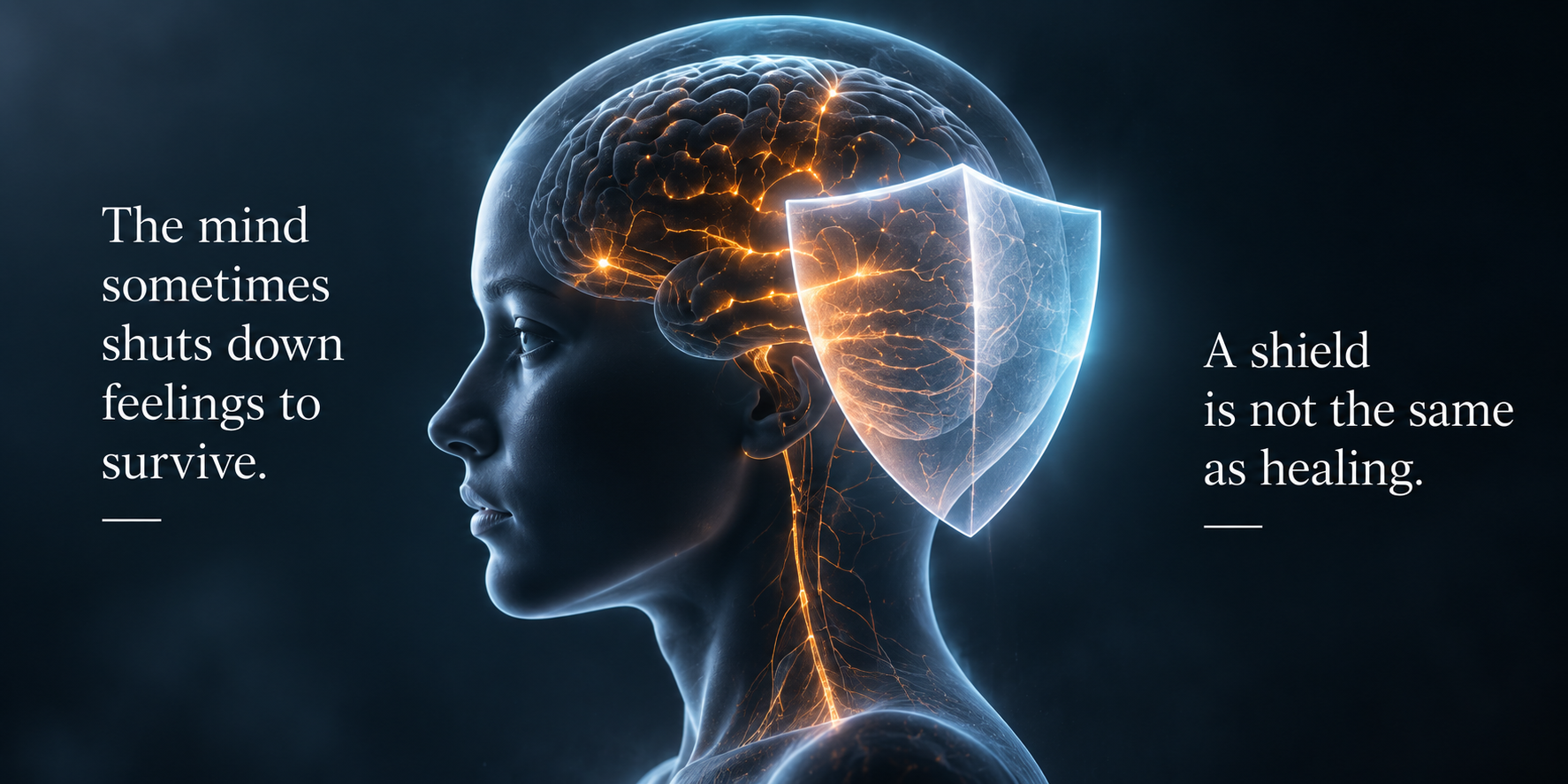
The most popular explanation of emotional numbness is that the mind shuts down feelings when pain becomes unbearable.
There is truth in that explanation.
After trauma or extreme stress, people may feel detached from themselves, from others, or from the world around them. The NHS describes dissociation as one way the mind may cope with too much stress, while trauma-related conditions can involve social isolation, loss of interest, and difficulty experiencing positive emotions. (National Institute of Mental Health)
In that sense, numbness can function like a shield.
When feeling everything seems dangerous, feeling nothing may appear safer.
But a shield is supposed to protect you during battle. It is not supposed to become your permanent home.
The problem begins when the danger has passed but the emotional distance remains. What once protected you from unbearable pain may eventually prevent you from experiencing trust, affection, pleasure, intimacy, and hope.
The nervous system may have learned to survive.
It may not yet have learned that it is safe to live.
Why Do We Become Emotionally Numb?
There is no single explanation that fits everyone.
Trauma and prolonged emotional overwhelm
After frightening, violent, humiliating, or deeply distressing experiences, a person may avoid thoughts and feelings connected to what happened. Some describe watching their life from a distance or feeling as though the world has become unreal, lifeless, or foggy.
Trauma-related numbness can exist beside anxiety and hypervigilance. A person may therefore appear emotionally flat while their body remains tense, alert, and prepared for danger. PTSD can include detachment, social isolation, diminished interest, and difficulty feeling happiness or satisfaction. (National Institute of Mental Health)
This is one reason “You do not look traumatized” is such a careless statement.
Trauma does not have one face.
Sometimes it screams.
Sometimes it disappears behind a perfectly controlled expression.
Depression and the loss of emotional range
Depression is not always experienced as intense sadness.
For some people, it feels more like emptiness, apathy, disconnection, or the disappearance of emotional colour. Emotional blunting may be part of depression itself, including after the most severe symptoms have begun to improve. (National Institute of Mental Health)
It is also useful to separate several experiences that are often mixed together:
Anhedonia mainly refers to reduced interest in or pleasure from activities.
Apathy centres more on reduced motivation and goal-directed behaviour.
Emotional blunting refers to a broader reduction in emotional intensity.
They can overlap, but they are not identical. Someone may still complete every responsibility while feeling no satisfaction, warmth, excitement, or emotional reward from doing so. (PubMed Central (PMC))
Grief and shock
Numbness can also be part of grief.
After a major loss, the reality may be too large to absorb immediately. Some people cry continuously; others feel almost nothing. Neither reaction, by itself, proves that someone loved more or less.
Periods of sorrow, disbelief, anger, guilt, and numbness can all occur during grief. In many cases, these reactions gradually change as the loss is processed. (Mayo Clinic)
Not every emotionally numb period is therefore a disorder.
Context matters.
Duration matters.
Most importantly, the effect on a person’s daily life matters.
Medication-related emotional blunting
Medication deserves particular care and honesty.
Some people taking antidepressants, especially SSRIs or SNRIs report feeling emotionally blunted. Studies have produced varying estimates, with several reporting the experience among a substantial proportion of treated patients. However, researchers still debate how much of the numbness comes from medication and how much represents remaining symptoms of depression. (PubMed Central (PMC))
That uncertainty is precisely why someone should not diagnose the cause alone.
A person experiencing emotional blunting while taking medication should discuss it with the prescribing clinician. Antidepressants should not be stopped abruptly or changed without medical guidance because sudden discontinuation can produce significant withdrawal symptoms and worsen emotional distress. (nhs.uk)
The answer is not necessarily “stop the medicine.”
The answer is “have an informed conversation.”
How Numbness Hides Inside a Functional Life
Emotional anesthesia does not always make a person incapable of living.
Sometimes it makes them extraordinarily functional.
They continue because stopping would require feeling.

They build routines so strict that no emotion has enough space to interrupt them. They keep the television running, the phone scrolling, the music playing, and the calendar full. Silence becomes uncomfortable because silence may allow something buried to knock on the door.
Emotional numbness may feel like:
Knowing that you love someone without feeling emotionally close to them.
Laughing while sensing that the laughter never reaches inside.
Receiving important news and reacting only because you know how you are expected to react.
Losing interest in music, conversations, celebrations, intimacy, or activities that once mattered.
Feeling indifferent toward outcomes that previously carried emotional meaning.
Struggling to cry, even while knowing that something hurts.
Feeling as though you are observing your life rather than inhabiting it.
Saying “I don’t care” when the more accurate truth is “I cannot reach what I feel.”
These experiences are not a diagnostic checklist. They can have many explanations.
But when they persist, worsen, or begin damaging relationships and daily functioning, they deserve attention rather than admiration.
Being able to survive without feeling is not the same as being well.
Peace and Numbness Are Not the Same
Peace has often been confused with emotional absence.
But peace is not empty.
Peace can hold sadness without being destroyed by it. It can experience joy without desperately trying to preserve it. It remains connected to the present even when the present is difficult.

Numbness feels different.
Peace says:
“I feel this, but it does not control me.”
Numbness says:
“I know something should be here, but I cannot find it.”
Similarly, dissociation is not simply calmness. It may involve feeling disconnected from oneself or the world, observing oneself from outside, or experiencing surroundings as unreal, lifeless, distant, or foggy. (nhs.uk)
These distinctions are important because our culture often rewards emotional suppression.
We praise the person who never cries.
We admire the one who remains available to everyone.
We call emotional distance maturity, even when it is exhaustion wearing a clean shirt.
But the inability to feel is not emotional mastery.
Sometimes it is emotional depletion.
The Cost of Feeling Nothing
At first, numbness may feel like relief.
The memories stop cutting as deeply. Rejection becomes easier to tolerate. Disappointment loses its power. You no longer spend nights begging the past to become different.
But emotional life rarely offers a separate volume control for every feeling.

When emotional range becomes restricted, pain may become quieter, but affection, curiosity, excitement, tenderness, and intimacy may also fade. Research on emotional blunting describes diminished positive and negative emotion, while trauma-related numbing can contribute to withdrawal and difficulty maintaining emotional closeness in relationships. (PubMed Central (PMC))
The people around you may misread your distance.
They may think you stopped caring.
You may think so too.
But sometimes the love is still there. It is simply trapped behind a door that was locked during a different emergency.
The tragedy of emotional anesthesia is therefore not that a person becomes heartless.
It is that the heart may still be speaking while the person has lost access to its language.
The Slow Return to Feeling
Emotions do not always return through one dramatic breakthrough.
Sometimes they return in fragments.
A song suddenly feels different.
A particular smell brings back a memory.
Someone asks the right question, and your throat tightens before you understand why.
You become irritated after months of indifference.
You cry over something small because the tears were never only about that moment.
These are not failures.
They may be signs that something inside you is becoming reachable again.
Stop demanding a dramatic emotion
Repeatedly asking, “Why can’t I feel anything?” can turn emotion into another performance requirement.
Instead, begin with smaller observations:
What is happening in my body?
Do I feel heavy, restless, tense, warm, cold, tired, or disconnected?
Do I want to move closer to something or farther away from it?
What moment today carried even one percent more emotional weight than the others?
You do not need to manufacture happiness.
You are simply rebuilding awareness.
Let the body participate
Emotional reconnection is not always achieved by thinking harder.
Walking, breathing slowly, exercising, maintaining regular sleep and meals, practising mindfulness, and returning to manageable routines can support emotional regulation and recovery. NIMH recommends exercise, mindfulness, realistic goals, consistent routines, and time with trusted people as supportive practices alongside appropriate treatment. (National Institute of Mental Health)
The purpose is not to “hack” yourself into feeling.
It is to give your mind and body enough stability to stop treating every emotion as a threat.
Tell one person the accurate truth
You do not need to deliver a perfect explanation.
You can simply say:
“I am not exactly sad. I just feel far away from everything.”
Or:
“I know I care, but I cannot feel connected right now.”
Honest language gives another person the opportunity to meet the reality you are experiencing rather than the performance you have been maintaining.
Social support can be an important part of trauma recovery, while talking therapies may help people understand underlying causes and learn ways to manage periods of disconnection. (National Institute of Mental Health)
Choose someone who can listen without immediately trying to repair you.
Not every silence needs advice.
Some silences first need company.
Seek professional assessment when the numbness remains
A mental-health professional can help explore whether the experience is connected to trauma, depression, dissociation, grief, medication, or another concern.
Psychotherapy is not merely a place to describe pain. It can help people identify patterns, understand triggers, process difficult experiences, and gradually reconnect thoughts, emotions, behaviours, and physical sensations. Different underlying conditions may require different therapeutic approaches. (National Institute of Mental Health)
Getting support does not mean your mind failed to protect you.
It may mean the protection worked, and now you need help putting the shield down.
When the Silence Needs Urgent Attention
Emotional numbness should not be treated as a personality trait when it is interfering with your relationships, work, sleep, self-care, or ability to remain present.
Seek professional support especially when the numbness:
Continues for an extended period or keeps worsening.
Is accompanied by severe hopelessness or social withdrawal.
Makes you feel unreal, detached from your body, or disconnected from reality.
Leads you to rely on alcohol, drugs, self-harm, or dangerous behaviour just to feel something.
Comes with thoughts of suicide or a belief that life is no longer worth continuing.
If you are in immediate danger or believe you may hurt yourself, contact local emergency services, go to the nearest emergency department, and tell a trusted person who can remain with you. Suicidal thoughts and self-harm require immediate, serious support, not secrecy or self-judgment. (nhs.uk)
Closing Thoughts: Your Heart Is Not Gone
Perhaps you are not cold.
Perhaps you have simply been standing guard for too long.
Perhaps your mind became tired of deciding which pain was safe to feel, so it lowered the volume on everything.
That may have helped you survive.
But survival strategies are not always suitable as permanent ways of living.
A wall that once stopped danger can eventually stop love too.
So do not hate yourself for becoming numb. But do not romanticize the numbness either. It deserves compassion, curiosity, and, when necessary, professional attention.
Feeling again may not begin with joy.
It may begin with discomfort.
With a tear you did not expect.
With anger you had buried.
With a song that suddenly refuses to remain in the background.
Let those small emotions arrive.
Do not interrogate them.
Do not ask them to prove that you are healed.
Simply make room.
Because your heart may not have forgotten how to feel.
It may only be waiting to believe that feeling is safe again.
Your numbness may have protected you from yesterday. It does not have to become your permanent address.
Your Turn: Have You Ever Felt Emotionally Absent?
Have you ever passed through a season when neither happiness nor sadness could fully reach you?
What helped you feel present again,a person, a conversation, a song, therapy, solitude, faith, movement, or simply time?
Share only what feels safe.
Sometimes the first step toward feeling again is discovering that we were never the only ones who went numb.
About the author
Self-driven, quick starter, passionate programmer with a curious mind who enjoys solving a complex and challenging real-world problems.
Comments
Join the discussionNo comments yet. Be the first to comment.


